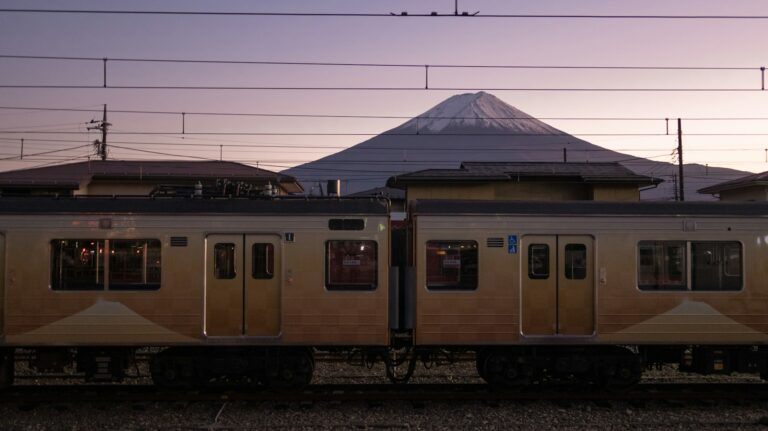
Hakone or Kawaguchiko? Which Fuji Destination Fits Your Japan Trip?

Last updated: September 2026
Hakone and Kawaguchiko are two of the most popular places to include between Tokyo and the rest of a first Japan itinerary.
They are often presented as interchangeable Mount Fuji destinations.
They are not.
Kawaguchiko is usually the stronger choice when seeing Mount Fuji is your main priority. Hakone is generally better for onsen, traditional ryokan, art museums and a convenient journey from Tokyo toward Kyoto or Osaka.
The correct destination depends on what you actually expect from the trip.
Choose Hakone when you want:
- a traditional ryokan and onsen experience;
- a private bath;
- several activities even when Mount Fuji is hidden;
- an easy addition between Tokyo and Kyoto;
- museums, volcanic scenery and Lake Ashi;
- a destination that does not depend entirely on one mountain view.
Choose Kawaguchiko when you want:
- a closer and more dominant view of Mount Fuji;
- landscape photography;
- a Fuji-view hotel room;
- lakeside scenery;
- Chureito Pagoda, Fujiyoshida or the Fuji Five Lakes;
- a slower stay built primarily around the mountain.
For most first-time travellers following Tokyo → Mount Fuji area → Kyoto, I would choose Hakone.
For photographers, repeat visitors and anyone who would be deeply disappointed without a close Fuji experience, I would choose Kawaguchiko—but only with realistic expectations about the weather.
Hakone vs Kawaguchiko at a glance
| Factor | Hakone | Kawaguchiko |
|---|---|---|
| Best for | Onsen, ryokan and varied sightseeing | Mount Fuji views and photography |
| Fuji views | Possible from selected locations | More prominent from many lake-area locations |
| Guaranteed view? | No | No |
| Access from Tokyo | Easy from Shinjuku or through Odawara | Direct bus or limited-express train from Tokyo |
| Onward to Kyoto | Comparatively easy through Odawara | More complicated, usually via Mishima or Shin-Fuji |
| Onsen selection | Excellent | Good, particularly in Fuji-view hotels |
| Activities in poor weather | Strong museums and indoor options | More limited, although museums and cultural sites exist |
| Local transport | Extensive but complex network | Sightseeing buses, trains and local buses |
| Best stay length | One or two nights | One or two nights |
| Day-trip suitability | Possible, but the full loop is demanding | Possible, but heavily dependent on visibility |
| Couples and honeymoon | Excellent | Excellent with the right Fuji-view property |
| Families | Good variety, but many transfers | Simpler concept, but attractions are spread out |
| Photographers | Good | Usually better |
ACCOMMODATION COMPARISON
[Compare Ryokan and Hotels in Hakone]
[Find Hotels With Mount Fuji Views in Kawaguchiko]
The most important difference: what happens when Mount Fuji is hidden?
Mount Fuji is not guaranteed from either Hakone or Kawaguchiko.
Clouds, haze, humidity and changing weather can hide all or part of the mountain. Even a hotel advertised as having Fuji views can only provide the view when conditions cooperate.
This matters because the two destinations react differently to poor visibility.
Hakone without Mount Fuji
A cloudy Hakone day can still include:
- the Hakone Open-Air Museum;
- Pola Museum of Art;
- Hakone Glass Forest Museum;
- an onsen;
- ryokan time;
- Owakudani, when access is operating;
- Lake Ashi;
- Hakone Shrine;
- scenic trains and cable cars.
Hakone’s official transport system connects its principal areas using trains, buses, a cable car, ropeway and sightseeing cruise. The Hakone Freepass covers eight participating transport modes and discounts at selected attractions. (箱根ナビ)
Kawaguchiko without Mount Fuji
Kawaguchiko still has:
- lakeside walks;
- museums;
- ropeway access;
- cafés;
- hot springs;
- cycling;
- Fuji-related cultural sites;
- nearby lakes and caves.
However, the emotional centre of most Kawaguchiko trips is the mountain itself.
Lake Kawaguchiko is the principal gateway to the Fuji Five Lakes and has well-developed tourism infrastructure, including accommodation, hot springs, cruises and outdoor activities. Its visual appeal is nevertheless strongly connected to the relationship between the lake and Mount Fuji.
Decision: choose Hakone when you want a destination that remains varied in poor visibility. Choose Kawaguchiko when you accept the weather risk in exchange for a potentially much stronger Fuji experience.
Which has the better view of Mount Fuji?
Kawaguchiko normally wins.
Mount Fuji is larger, closer and more central to the landscape around the northern shore of Lake Kawaguchiko, Oishi Park and several surrounding viewpoints.
You can also build an entire stay around different perspectives:
- the northern lakeshore;
- Oishi Park;
- the Mount Fuji Panorama Ropeway;
- Chureito Pagoda;
- Fujiyoshida;
- nearby Lake Saiko or Lake Yamanakako;
- a hotel room or private bath facing the mountain.
Official Yamanashi tourism guidance identifies Kawaguchiko as the most visited of the Fuji Five Lakes and highlights several lake and bridge viewpoints used by photographers.
Hakone can provide beautiful views from areas around:
- Lake Ashi;
- Moto-Hakone;
- the sightseeing cruise;
- Owakudani;
- elevated roads and hotel viewpoints.
But Mount Fuji is not visible throughout Hakone. The destination covers a wide and mountainous area, and many popular hotels or attractions do not face the mountain.
Official Hakone guidance specifically identifies Lake Ashi and parts of the local transport network as places where Mount Fuji may be visible on fine days. (箱根ナビ)
The visibility rule
Plan the most important Fuji viewpoint for the morning and check local forecasts or live cameras before committing to a long journey.
Fuji City maintains records of how frequently the mountain is visible and official Yamanashi tourism provides multiple live-camera views of the mountain. (city.fuji.shizuoka.jp)
Do not make a non-refundable trip successful or unsuccessful based exclusively on one photograph.
FUJI EXPERIENCES
Which is better for onsen and ryokan?
Hakone is the stronger overall onsen destination.
It has several accommodation areas with different atmospheres:
- Hakone-Yumoto;
- Miyanoshita;
- Gora;
- Kowakudani;
- Sengokuhara;
- Moto-Hakone;
- Lake Ashi.
This creates a much wider choice of:
- traditional ryokan;
- luxury hotels;
- public onsen;
- reservable private baths;
- rooms with open-air baths;
- properties with Japanese or western beds;
- meal-inclusive stays.
Hakone’s official visitor guide presents hot springs, accommodation and transport as central parts of the destination and shows that hotels and ryokan are distributed across several separate areas. (箱根ナビ)
Kawaguchiko also has excellent ryokan and onsen hotels, including rooms and baths with spectacular Fuji views.
Its strongest properties can provide a more visually dramatic stay than Hakone—when the mountain is visible.
The distinction is:
- choose Hakone for the complete onsen and ryokan experience;
- choose Kawaguchiko for the possibility of bathing or waking up with Mount Fuji in front of you.
What to check before booking a ryokan
Confirm:
- whether dinner and breakfast are included;
- dinner check-in deadline;
- whether the bath is genuinely private;
- whether the room bath uses hot-spring water;
- tattoo policy;
- room view;
- transport from the station;
- luggage-forwarding acceptance;
- western beds or futons;
- cancellation policy.
A room described as “Fuji side” does not guarantee that the entire mountain will be visible from the bath, bed or balcony.
RYOKAN
[Find Hakone Ryokan With Private Onsen]
[Find Kawaguchiko Hotels With Private Baths and Fuji Views]
Which is easier to reach from Tokyo?
Both are accessible, but the experience is different.
Tokyo to Hakone
The most attractive leisure route is the Odakyu Romancecar from Shinjuku toward Hakone-Yumoto.
Travellers starting from Tokyo Station or continuing later to Kyoto may instead use the Tokaido Shinkansen or other rail services to reach Odawara, then enter the Hakone transport network.
Hakone’s official guide describes the Romancecar as the fastest direct option from Shinjuku and identifies Odawara as the gateway for travellers using the Shinkansen. (箱根ナビ)
This gives Hakone two practical advantages:
- direct access from Shinjuku;
- access through a Shinkansen station.
HAKONE TRANSPORT
[Check Romancecar Tickets From Shinjuku]
[Check the Hakone Freepass]
Tokyo to Kawaguchiko
The most common options are:
- highway bus from Shinjuku or other Tokyo terminals;
- the Fuji Excursion limited-express train;
- JR services to Otsuki followed by the Fujikyu Railway;
- rental car;
- organised tour.
Direct highway buses connect Tokyo locations with Kawaguchiko and the Fuji Five Lakes. Kawaguchiko tourism also lists buses from Shinjuku, Tokyo Station, Haneda and Narita among the access possibilities. (高速バスドットコム)
The Fuji Excursion operates through to Fujikyu Railway destinations including Mt. Fuji Station and Kawaguchiko. Seat availability may be limited, particularly on popular travel dates. (e.fujikyu-railway.jp)
Bus or train?
Choose the bus when:
- the departure terminal is convenient;
- the fare is attractive;
- you want a direct journey;
- road traffic is unlikely to affect an important connection.
Choose the train when:
- you prefer rail;
- road delays would create stress;
- you want a reserved seat;
- the timetable fits the itinerary.
A bus can be delayed by weekend or holiday traffic, particularly on routes used by large numbers of visitors.
AFFILIATE PLACEMENT — KAWAGUCHIKO TRANSPORT
[Book a Bus From Tokyo to Kawaguchiko]
[Check Fuji Excursion Train Availability]
Which is better between Tokyo and Kyoto?
Hakone is considerably more convenient.
A practical route is:
- Tokyo or Shinjuku to Hakone;
- overnight in Hakone;
- return to Odawara;
- Tokaido Shinkansen toward Kyoto.
Hakone’s official tourism site explicitly promotes the destination as being positioned between Tokyo and western Japan, with access to Kyoto and Osaka through the Shinkansen at Odawara. (箱根ナビ)
From Kawaguchiko, onward travel to Kyoto usually requires one of these approaches:
- bus toward Mishima, followed by Shinkansen;
- bus toward Shin-Fuji, followed by rail;
- return toward Tokyo and then take the Shinkansen;
- rental car to a suitable station.
Fujikyu operates local routes connecting the Kawaguchiko area with Gotemba, Mishima and Shin-Fuji corridors. (bus.fujikyu.co.jp)
This route is possible, but it involves more timetable coordination.
My practical recommendation
For:
Tokyo → Fuji area → Kyoto
choose Hakone unless Mount Fuji photography is a defining priority.
For:
Tokyo → Fuji area → Tokyo
Kawaguchiko becomes much easier to justify.
Not sure how to fit Mount Fuji between Tokyo and Kyoto?
I can build the route around your hotel, luggage, transport preferences and the experiences that matter most.
Which is better as a day trip from Tokyo?
Neither is ideal when you want a relaxed experience.
Hakone day trip
A Hakone day trip can include part of the classic loop:
- Hakone-Yumoto;
- Gora;
- cable car;
- ropeway;
- Owakudani;
- Lake Ashi;
- sightseeing cruise;
- Hakone Shrine.
Hakone’s official model course begins early in Shinjuku and uses a full day to connect the principal sights. (箱根ナビ)
Trying to include every stop creates a transport-heavy day, especially when:
- queues are long;
- the ropeway is suspended;
- buses are crowded;
- you stop for lunch;
- you visit a museum;
- you travel with children.
The ropeway can be suspended because of poor weather, inspection or maintenance, so the loop should never be treated as operationally guaranteed. (箱根ナビ)
Kawaguchiko day trip
Kawaguchiko works as a day trip when:
- the forecast is clear;
- you depart early;
- you select only a few locations;
- you reserve transport;
- you accept that visibility can change.
A realistic day might include:
- northern lakeshore or Oishi Park;
- the ropeway;
- one additional museum or viewpoint.
Do not attempt the lake, Chureito Pagoda, Oshino Hakkai, Fuji-Q Highland and several other lakes in one independent day without a car.
Day-trip verdict
Choose Hakone when you want varied sightseeing.
Choose Kawaguchiko when you want a focused Fuji-view day and can respond to the forecast.
For both destinations, an overnight stay provides a major advantage: you gain an early morning, when the area is quieter and you have another opportunity for clear visibility.
Which is better for an overnight stay?
Both become much better destinations when you stay one night.
Why stay overnight in Hakone?
An overnight stay allows you to:
- enjoy the ryokan rather than use it only as a bed;
- have kaiseki-style dinner and breakfast;
- use the onsen;
- divide sightseeing across two days;
- avoid completing the full transport loop under time pressure;
- continue to Kyoto the following morning.
Why stay overnight in Kawaguchiko?
An overnight stay gives you:
- an evening and a morning for Fuji visibility;
- quieter lakeside hours;
- sunset and sunrise photography;
- the possibility of seeing the mountain from your room;
- time to explore beyond the most congested day-trip circuit.
For Kawaguchiko, the additional morning can be more valuable than adding another attraction.
Is two nights too much?
Two nights work well when:
- the hotel is part of the experience;
- you have a private onsen;
- you want photography flexibility;
- you have a car;
- you plan to explore multiple Fuji Five Lakes;
- you want a slower honeymoon stay.
For an ordinary first two-week itinerary, one night is usually sufficient.
OVERNIGHT STAYS
[Compare One-Night Ryokan Stays in Hakone]
[Compare Two-Night Fuji-View Stays in Kawaguchiko]
Hakone or Kawaguchiko for a honeymoon?
Choose Hakone when you prioritise:
- luxury ryokan;
- private onsen;
- traditional meals;
- a polished accommodation experience;
- convenient continuation to Kyoto;
- activities that still work when the weather is poor.
Choose Kawaguchiko when you prioritise:
- waking up in front of Mount Fuji;
- photography;
- lake scenery;
- a private bath with a mountain view;
- a quieter, landscape-centred stay.
The ideal honeymoon choice depends heavily on the property.
A beautiful Kawaguchiko room with an unobstructed Fuji view may be more memorable than an ordinary Hakone hotel. A high-quality Hakone ryokan may offer a far stronger overall experience than a basic hotel chosen only for a possible mountain view.
Read Also:
Japan Honeymoon Itinerary: A Romantic Two-Week Trip
Hakone or Kawaguchiko with children?
Hakone provides greater activity variety:
- trains;
- cable car;
- ropeway;
- sightseeing boat;
- Open-Air Museum;
- volcanic landscape;
- family-oriented accommodation.
The disadvantage is the number of transport changes.
Kawaguchiko is conceptually simpler but still requires buses, taxis, bicycles or a car to connect different lakeside locations.
Choose Hakone for children who enjoy transport and varied attractions.
Choose Kawaguchiko for a slower hotel-centred stay, photography-minded families or a visit that also includes Fuji-Q Highland.
For younger children, avoid building the day around repeated bus changes and long waits.
Read Also:
Japan With Kids: A Realistic Family Itinerary
Hakone or Kawaguchiko for photographers?
Choose Kawaguchiko.
It provides:
- more dominant mountain views;
- lakeside foregrounds;
- reflections;
- seasonal flowers;
- Chureito Pagoda;
- traditional streets in Fujiyoshida;
- more opportunities to change position according to light.
The official Kawaguchiko tourism site recommends beginning seasonal landscape routes in the morning, when some major sites are quieter and conditions may be calmer. (富士河口湖町観光情報サイト│FUJIKAWAGUCHIKO)
Hakone can produce beautiful compositions involving Lake Ashi, Hakone Shrine and Mount Fuji, but the number of dependable viewpoints is more limited.
Photographers should stay overnight and avoid scheduling Kawaguchiko as an inflexible day tour during a poor forecast.
Which destination is easier without a car?
Both can be visited without a car.
Hakone without a car
Hakone is designed around public transport, but it is not simple in the same way as central Tokyo.
The network includes:
- railway;
- cable car;
- ropeway;
- buses;
- sightseeing cruise.
This allows you to complete a circuit without driving, but queues and connections influence the pace. The official Hakone guide provides live service information because interruptions can affect the route. (箱根ナビ)
Kawaguchiko without a car
Use:
- sightseeing buses;
- local buses;
- train;
- taxi;
- bicycle;
- organised tours.
The Mt. Fuji Pass provides unlimited use of participating buses and trains in the Fuji area for two or three days. (bus.fujikyu.co.jp)
Public transport is sufficient for the main lake, but visiting several Fuji Five Lakes or dispersed viewpoints becomes easier with a car.
Car-free verdict
Hakone has the more comprehensive transport system.
Kawaguchiko is easier when you choose a hotel near your preferred sights and limit the number of areas.
What to do in Hakone
A strong one-night itinerary does not need every attraction.
Day 1
- Travel from Tokyo to Hakone.
- Leave luggage or check in.
- Visit the Open-Air Museum or another selected museum.
- Continue to Gora or the ryokan.
- Enjoy the onsen and dinner.
Day 2
- Travel toward Owakudani when operating.
- Continue toward Lake Ashi.
- Take the sightseeing cruise.
- Visit Hakone Shrine or Moto-Hakone.
- Return through Odawara and continue to Kyoto.
Do not schedule an early Kyoto attraction on the same day. Hakone transport and the Shinkansen transfer already create a full travel day.
HAKONE ACTIVITIES
What to do in Kawaguchiko
A strong overnight itinerary should use weather conditions rather than follow a rigid order.
Day 1
- Travel from Tokyo.
- Leave luggage at the hotel.
- Visit the northern lakeshore or Oishi Park.
- Choose the panorama ropeway or a museum.
- Check in and enjoy the hotel.
Day 2
When the mountain is clear:
- photograph the lake early;
- continue to Chureito Pagoda or Fujiyoshida;
- visit Oshino Hakkai or another viewpoint;
- return to Tokyo or continue via Mishima.
When the mountain is hidden:
- visit a museum;
- explore local food;
- use the onsen;
- visit caves or forested areas;
- avoid spending the day moving repeatedly between identical cloudy viewpoints.
KAWAGUCHIKO ACTIVITIES
[Browse Kawaguchiko Sightseeing Tours]
[Find a Fuji-View Hotel Near the Northern Shore]
Where should you stay in Hakone?
The term “Hakone hotel” covers several very different areas.
Hakone-Yumoto
Best for:
- easiest access from Tokyo;
- restaurants and shops;
- a short one-night stay;
- travellers who do not want complex local transport.
Less suitable for:
- immediate Lake Ashi access;
- guaranteed Fuji views;
- feeling deeply surrounded by mountain scenery.
Gora and Kowakudani
Best for:
- museums;
- access toward the cable car and ropeway;
- luxury ryokan;
- a central sightseeing position.
Sengokuhara
Best for:
- museums;
- quieter accommodation;
- open landscapes;
- travellers comfortable using buses.
Moto-Hakone and Lake Ashi
Best for:
- lakeside atmosphere;
- Hakone Shrine;
- possible Fuji views;
- slower resort stays.
The disadvantage is the longer journey back toward Odawara.
Affiliate button:
[Compare the Best Areas to Stay in Hakone]
Where should you stay in Kawaguchiko?
Near Kawaguchiko Station
Best for:
- public transport;
- bus departures;
- Fuji Excursion;
- short stays;
- onward travel.
The station area is practical but not always the strongest choice for uninterrupted lake-and-Fuji views.
Southern and eastern lakeshore
Best for:
- access to the station area;
- restaurants;
- ropeway;
- visitor facilities.
Northern shore
Best for:
- some of the strongest lake-and-Fuji compositions;
- Oishi Park;
- quieter mornings;
- Fuji-view accommodation.
Check whether the hotel provides a station shuttle. A beautiful northern-shore property may be inconvenient without one.
What is the best season?
Winter
Winter usually provides the strongest reason to choose Kawaguchiko:
- colder and often clearer conditions;
- snow-capped Mount Fuji;
- strong photography;
- winter onsen.
Official Yamanashi tourism describes winter as a particularly compelling period for viewing Mount Fuji. (〖公式〗富士の国やまなし観光ネット 山梨県公式観光情報)
Hakone is also attractive in winter, particularly for onsen and views around Lake Ashi when conditions are clear.
Spring
Spring brings cherry blossoms and increasingly green landscapes.
Kawaguchiko and Fujiyoshida can become extremely busy at famous blossom viewpoints. Accommodation should be booked early.
Hakone offers flowers, gardens and comfortable sightseeing, although the mountain may be affected by spring haze.
Summer
Summer brings green scenery, lavender around Kawaguchiko and access to the Mount Fuji climbing season.
Lake Kawaguchiko’s higher elevation produces comparatively cooler summers, and lavender generally becomes a major attraction from late June into July. (富士河口湖町観光情報サイト│FUJIKAWAGUCHIKO)
However, summer humidity and cloud formation can reduce the likelihood of a complete Fuji view.
Choose Kawaguchiko in summer for the complete lake area, not for a guaranteed mountain photograph.
Autumn
Both destinations are excellent.
Hakone provides foliage around Lake Ashi, museums and mountain slopes.
Kawaguchiko combines autumn leaves with Mount Fuji and the lakes, creating extremely popular photographic conditions.
Expect weekend congestion and higher hotel demand.
Can you visit both Hakone and Kawaguchiko?
Yes, but not comfortably as a single rushed day.
The areas are connected through transport corridors involving Gotemba and local buses. Kawaguchiko has bus links toward Gotemba, while Hakone’s network also extends toward the Gotemba area. (bus.fujikyu.co.jp)
A realistic combined route needs at least two nights:
Day 1
Tokyo → Kawaguchiko
Stay in Kawaguchiko.
Day 2
Morning Fuji views → travel through the Gotemba corridor → Hakone
Stay in Hakone.
Day 3
Hakone sightseeing → Odawara → Kyoto.
This can work for travellers with enough time, but it adds:
- another hotel;
- another luggage transfer;
- bus coordination;
- greater exposure to transport disruption;
- less time in Tokyo or Kyoto.
For a 10- or 14-day first trip, choose one.
For a three-week itinerary, both may be reasonable.
Already included both Hakone and Kawaguchiko?
I can check whether the transfers, hotel locations and sightseeing time are realistic before you finalise the bookings.
Use luggage forwarding
Large luggage makes both destinations more difficult.
For a Tokyo → Hakone → Kyoto route:
- send the main suitcases from Tokyo to Kyoto;
- carry a small overnight bag to Hakone;
- collect the luggage at the Kyoto hotel.
Use the same strategy for Kawaguchiko, especially when travelling onward by bus toward Mishima or Shin-Fuji.
Confirm that the receiving hotel accepts luggage and allow sufficient delivery time.
Common Hakone and Kawaguchiko mistakes
Choosing Hakone solely to see Mount Fuji
Hakone is not a continuous Fuji viewpoint.
Choose it for the complete destination.
Choosing Kawaguchiko because the view is “guaranteed”
A Fuji-view room guarantees the direction of the room, not the weather.
Visiting both in one day
The areas are not adjacent sightseeing neighbourhoods.
Completing the entire Hakone loop with suitcases
Send luggage ahead or leave it at the accommodation.
Booking the wrong Hakone area
A property beside Lake Ashi has very different transport requirements from one near Hakone-Yumoto.
Choosing a Kawaguchiko hotel without checking its shuttle
The strongest views may be away from the station.
Planning Kawaguchiko only as a midday visit
Morning usually gives you a better strategic opportunity for visibility and quieter viewpoints.
Continuing to Kyoto without checking the bus connection
Kawaguchiko to Mishima or Shin-Fuji needs timetable coordination.
Buying a transport pass automatically
Compare your exact route and included transport before purchasing the Hakone Freepass, Fuji Hakone Pass or Mt. Fuji Pass.
Making Mount Fuji the only success criterion
A hidden mountain should not destroy an otherwise valuable ryokan, onsen or lake stay.
Frequently asked questions
Is Hakone or Kawaguchiko better for seeing Mount Fuji?
Kawaguchiko is normally better because the mountain is closer and more dominant from several lakeside viewpoints.
Neither destination guarantees visibility.
Is Hakone or Kawaguchiko better for a first Japan trip?
Hakone is usually easier to integrate into a first Tokyo–Kyoto itinerary.
Kawaguchiko is better when Mount Fuji itself is one of the trip’s principal objectives.
Which is better for a day trip?
Hakone is better for varied sightseeing.
Kawaguchiko is better for a weather-dependent Fuji-view trip.
Both are significantly better with one overnight stay.
Which is better for a ryokan?
Hakone has the stronger overall selection of traditional ryokan and onsen experiences.
Kawaguchiko’s best properties can offer exceptional Fuji views.
Is Kawaguchiko an onsen town?
Yes. The area has hot-spring hotels and ryokan, including properties with private baths and Mount Fuji views.
Hakone nevertheless offers a broader onsen-focused destination.
Which is easier from Shinjuku?
Both have direct options.
Hakone can be reached by Romancecar, while Kawaguchiko is served by highway buses and limited-express rail services.
Which is easier from Tokyo Station?
Hakone can be reached efficiently through Odawara.
Kawaguchiko has direct bus options from Tokyo, but the best choice depends on schedule and traffic.
Which is easier before Kyoto?
Hakone.
Odawara is on the Tokaido Shinkansen corridor, while Kawaguchiko usually requires a bus toward Mishima or Shin-Fuji, or a return toward Tokyo.
How many nights should I spend?
One night is enough for most first-time itineraries.
Choose two nights for a resort stay, photography flexibility, a honeymoon or broader Fuji Five Lakes exploration.
Can I visit Hakone and Kawaguchiko without a car?
Yes.
Both have public transport, although a car provides more flexibility around the Fuji Five Lakes.
Should I book a Mount Fuji tour?
A tour can be useful when you:
- have only one day;
- do not want to coordinate local buses;
- want several viewpoints;
- prefer a guide;
- accept a fixed itinerary.
Check the cancellation and poor-weather policies carefully.
Final verdict
Choose Hakone when you want the most complete and convenient experience.
It offers:
- stronger onsen and ryokan variety;
- museums and activities;
- a destination that remains interesting without Mount Fuji;
- easier travel between Tokyo and Kyoto.
Choose Kawaguchiko when Mount Fuji is the reason for the trip.
It offers:
- closer and more dramatic views;
- stronger photography;
- lake scenery;
- the possibility of a Fuji-view hotel or private bath.
My default recommendation is:
- first Tokyo–Kyoto trip: Hakone;
- photography or Fuji-focused trip: Kawaguchiko;
- honeymoon: depends on the property;
- day trip with uncertain weather: Hakone;
- clear winter forecast: Kawaguchiko;
- three-week itinerary: consider both.
The most important rule is not to choose from photographs alone.
Choose the destination that still fits your trip when the mountain is hidden.
Let me choose the right Fuji destination for your itinerary
I create personalised Japan routes based on your dates, hotel preferences, transport, photography priorities and onward journey.
Already have a plan? I can review your Hakone or Kawaguchiko stay, check the transfers and identify whether the schedule is realistic.
[Start Planning Your Japan Trip]
[Have Your Existing Itinerary Reviewed]
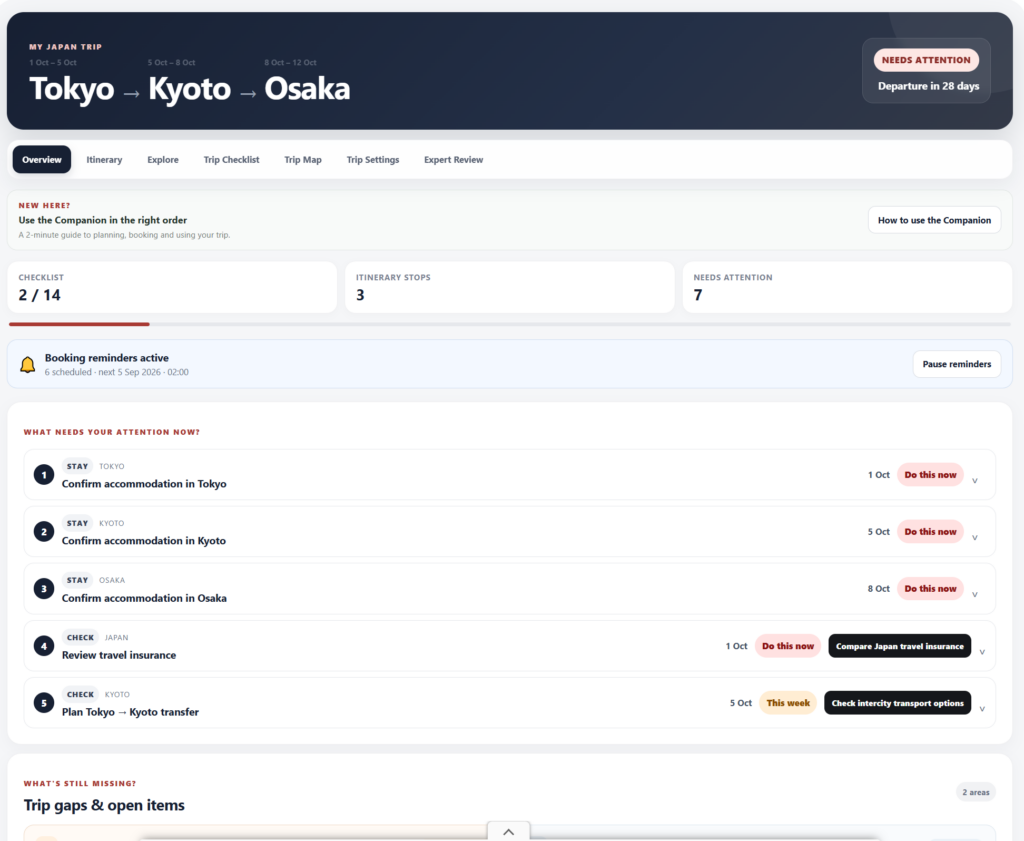
JAPAN TRAVEL COMPANION
Know What to Book — and When
Add your travel dates and destinations to see what needs booking, when tickets open and what to plan next.
✓ Personalized booking timeline
✓ Trip checklist and itinerary
✓ Planning reminders