3 Days in Hiroshima’s Coastal Towns: Tomonoura, Onomichi and the Shimanami Kaido
3 Days in Hiroshima’s Coastal Towns: Tomonoura, Onomichi and the Shimanami Kaido
Introduction
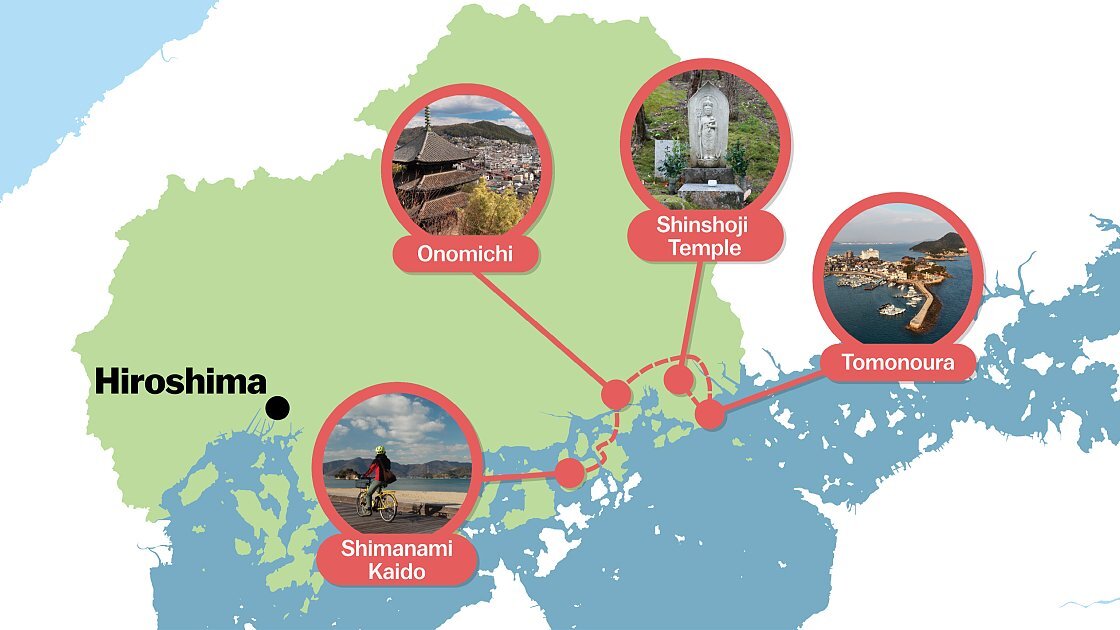
If you are looking beyond Hiroshima City and Miyajima, the Seto Inland Sea coast offers a slower kind of Japan trip: historic port towns, compact walkable streets, island views, and a route that combines trains, car travel, walking, ferry rides, and cycling. This three-day Hiroshima coast itinerary focuses on Tomonoura, Onomichi, and a half-day ride on the Shimanami Kaido.
It is a good fit for travelers who like to move at an unhurried pace while still seeing a lot in a short time.
Why this Hiroshima coastal route is worth adding to a Japan trip
Hiroshima Prefecture borders the Seto Inland Sea, which is surrounded by Honshu, Shikoku, and Kyushu. The region is known for seaside towns, coastal views, tranquil islands, and a mild climate.
While many travelers already know Hiroshima City and Miyajima, this route focuses on the coastal towns in the east and west of the prefecture. The appeal is in the mix: a Zen temple with gardens, a historic port town, a walkable seaside city, and a cycling day across islands.
Trip overview: how the 3 days are split
- Day 1: Fukuyama, Shinshoji Zen Museum and Gardens, and overnight in Tomonoura
- Day 2: Onomichi on foot, including the shopping arcade, temple slopes, and observatory, with an overnight at Hotel Cycle
- Day 3: A partial Shimanami Kaido cycling day from Onomichi toward the islands, with ferry and bike rental logistics
Day 1: Fukuyama, Shinshoji Zen Museum and Gardens, and overnight in Tomonoura
This itinerary begins at Fukuyama Station, which is on the Sanyo Shinkansen and about 60–70 minutes from Shin-Osaka Station.
From Fukuyama, the first stop is Shinshoji Zen Museum and Gardens. The temple is best reached by rental car or taxi because it is not well served by public transport. It takes about 30 minutes to drive there from Fukuyama Station.
Shinshoji is a Zen temple designed for ordinary visitors to experience Zen Buddhism in a practical, accessible way. Its grounds include gardens, recreated teahouses, a Zen Buddhist art museum, an immersive art installation, and a bathhouse. Some experiences, such as Zen meditation, sutra copying, and other workshops, require advance reservations.
A distinctive dining option here is Gokando, where the menu centers on Shinshoji Udon. The noodles are longer and thicker than regular udon, and the meal is served only a few times a month. That makes it more of a special experience than a casual everyday lunch stop.
After lunch, continue south to Tomonoura, a historic port town about 30 minutes by car from Shinshoji. Tomonoura is compact and best explored on foot, with the main sights in this itinerary roughly ten minutes apart.
Tomonoura highlights
Tomonoura has a long history as a port on the Seto Inland Sea. It sits around the midpoint of the inland sea where two tidal streams meet, which made it an important place for sailors waiting for favorable conditions before continuing their journeys.
The town is also known for homeishu, a medicinal liquor made with 16 herbs and spices. Four makers remain in Tomonoura, and the taste varies from company to company.
Tomonoura has also gained attention as a filming location setting for major movies, including The Wolverine and Studio Ghibli’s Ponyo.
Overnight stay in Tomonoura
For a waterfront stay, Migiwatei Ochi Kochi is a strong match for this route. The rooms come with private terrace baths overlooking the sea, and guests can also use three larger private baths on the property. There is also a lounge area with drinks, snacks, and a library.
Dinner at the property focuses on local produce and seafood. Tomonoura’s sea bream appears in the meal, and oysters are also served. This makes the overnight stay part of the experience rather than just a place to sleep.
Day 2: Onomichi on foot, including the shopping arcade, temple slopes, and observatory
After breakfast in Tomonoura, return to Fukuyama Station and continue west by local train on the JR Sanyo Line to Onomichi, a trip of about 20 minutes.
Onomichi is a mid-sized coastal city and the gateway to the Shimanami Kaido. Central Onomichi is compact and best explored on foot, which makes it a natural second stop for a slow-travel Hiroshima coast itinerary.
What to see and do in Onomichi
A good walking day can begin near Onomichi Station and continue through the Onomichi Hondori Shopping Arcade, which stretches for about 1.2 kilometers. Around 200 shops line the arcade, ranging from bakeries and coffee shops to restaurants, souvenir stores, daily goods, and produce.
One notable stop is Onomichi Hanpu, a canvas bag shop that reflects the town’s maritime roots. Canvas was once produced in large quantities here for sails, and the remaining factory now makes bags, pouches, and travel accessories.
From the downtown core, move uphill to the slopes north of the tracks. This is where many of Onomichi’s temples are located, along with the city museum and a hilltop observatory with views over the Seto Inland Sea.
A tea stop at Tea Stand Gen Yamate adds another local layer to the day. The shop specializes in organic tea from Hiroshima Prefecture and elsewhere in Japan, and the seating area is designed with a tea-ceremony feel.
At the top of the walk, Senkoji Park is a key viewpoint. You can walk up, but the ropeway is a good way to save energy for the rest of the day. The Senkoji Park Peak observatory is a spiral walkway leading to a long deck with views over Onomichi and the Seto Inland Sea.
On the way down, follow the Temple Walk, a route that passes several temples and includes a cat alley with cat statues and real cats. This part of Onomichi combines wide views, narrow lanes, temple stops, and a very walkable urban landscape.
Why Hotel Cycle works well here
The day ends at Hotel Cycle, located in ONOMICHI U2, a former port warehouse converted into a commercial complex with a hotel, restaurants, cafes, a bakery, a souvenir shop, and a bicycle shop.
For this itinerary, the location matters: the hotel is close to the Shimanami Kaido starting point and a bicycle rental terminal, which makes the next day simpler.
Day 3: A half-day Shimanami Kaido cycling route
The Shimanami Kaido connects Onomichi in Hiroshima Prefecture and Imabari in Ehime Prefecture across the Seto Inland Sea. It spans about 70 kilometers and passes across six major islands by bridge.
The route is clearly marked and does not contain major hills, which makes it possible to do a partial ride rather than the full crossing.
How the half-day cycling plan works
For a shorter version, start by renting a bicycle at the Onomichi Port Bicycle Rental Terminal beside Hotel Cycle. A range of bikes is available, including cross bicycles, city bicycles, kids’ bicycles, tandem bikes, and battery-assisted electric bicycles. Same-day rentals are accepted when bicycles are available, and reservations are recommended if you want to be sure of getting one.
Bicycle terminals are spread across the route, and most bicycles except tandem bikes can be returned at any terminal along the cycling course.
From Onomichi, take the ferry to Mukaishima and begin cycling there. The coast-hugging route on Mukaishima offers sea views before crossing to Innoshima.
A good break point is Hakko Park on Innoshima, which has a cafe, a vegetable garden, and a terrace overlooking the Seto Inland Sea.
The next bridge brings you to Ikuchijima. One sightseeing stop here is Kousanji Temple, a colorful temple complex founded in the 1930s by a businessman for his mother. Many of the buildings were modeled after famous temple structures from around Japan.
For the return, the bike can be dropped off at the rental terminal in Setoda. From there, the port-area shopping street is a pleasant place to pause, with cafes, shops, and public baths. You can then take the ferry back to Onomichi.
Getting around: what this itinerary involves
This Hiroshima coast itinerary uses several forms of transport, and that is part of its appeal.
- Shinkansen: Shin-Osaka to Fukuyama on the Sanyo Shinkansen
- Rental car: useful for reaching Shinshoji and Tomonoura efficiently
- Local train: Fukuyama to Onomichi on the JR Sanyo Line
- Walking: the best way to explore Tomonoura and central Onomichi
- Ropeway: an energy-saving option for reaching Senkoji Park
- Ferry: used between Onomichi and Mukaishima, and again for the return from Setoda to Onomichi
- Bicycle: the core of the Shimanami Kaido day
For Tomonoura, local buses run between Fukuyama Station and the town, but Shinshoji is not well served by public transportation, which is why a car or taxi makes the day easier.
Which rail passes may help for a wider Setouchi trip
Rail passes are worth considering if this is part of a broader Setouchi journey rather than a standalone 3-day trip.
The passes mentioned for the region include:
- Setouchi Area Pass
- Kansai – Hiroshima Area Pass
- JR-WEST All Area Pass
- Sanyo – San’in Area Pass
- Sanyo-San’in Northern Kyushu Pass
- Okayama – Hiroshima – Yamaguchi Area Pass
These passes allow unlimited travel on JR train lines, including bullet trains, and some also include select buses and ferries. They are valid for consecutive days and may be more useful when the Hiroshima coast route is combined with longer travel across the region.
Who this itinerary is best for
This route works especially well for travelers who want:
- a slower alternative to the standard Hiroshima City and Miyajima combination
- scenic coastal towns with strong local character
- a trip that balances sightseeing, walking, ferry travel, and cycling
- a practical, compact itinerary that still feels varied
- a Setouchi-style route that can be expanded with rail passes
Practical travel tips
- If you want to include Shinshoji and Tomonoura smoothly, a rental car is the easiest transport option for that first day.
- Book ahead for Shinshoji experiences if you want Zen meditation, sutra copying, or other workshops.
- If you want a specific bike type for the Shimanami Kaido, reserve in advance.
- For Onomichi, plan on walking. The downtown area, shopping arcade, slopes, and temple route all fit well into a walking day.
- If you want a shorter cycling day, the Onomichi-to-island section works well without doing the full route.
- If you are using a ferry with a bicycle, note that bringing a bike onboard costs extra.
FAQ
Is Hiroshima worth visiting for the coastal towns as well as Hiroshima City?
Yes, if you want a slower coastal trip. Hiroshima Prefecture includes seaside towns and islands along the Seto Inland Sea, and this itinerary shows how Tomonoura, Onomichi, and the Shimanami Kaido can fit into three days.
How do you get from Fukuyama to Tomonoura and Onomichi?
For Tomonoura, local buses run from Fukuyama Station, but a rental car or taxi is easier if you also want to visit Shinshoji. For Onomichi, take the JR Sanyo Line from Fukuyama Station.
Can you do the Shimanami Kaido without cycling the full route?
Yes. The route can be completed in one day, but this itinerary uses only the section from Onomichi through the islands to Setoda before returning by ferry.
Do you need a rental car for Shinshoji Temple and Tomonoura?
A car is not strictly the only option, but it is the most convenient way to combine Shinshoji and Tomonoura in one day because Shinshoji is not well served by public transport.
Is Onomichi walkable for sightseeing?
Yes. Central Onomichi is compact and best explored on foot, and the route from the station through the arcade, observatory, temple area, and Hotel Cycle works well as a walking day.
Where can you rent a bike for the Shimanami Kaido?
Bikes are available at the Onomichi Port Bicycle Rental Terminal beside Hotel Cycle, with terminals spread across the route for returns along the way.
Which Hiroshima-area rail passes may help on a wider Setouchi trip?
The region includes several passes that may help if you are combining Hiroshima with longer JR travel, including the Setouchi Area Pass and the Kansai – Hiroshima Area Pass.
How to include this route in a Japan itinerary
This is a strong add-on if you already plan to visit Hiroshima City or other parts of western Japan and want a more coastal, active, and scenic extension. The route also works well as a short standalone trip if you want to focus on historic port towns, island scenery, and a manageable cycling day without committing to a full-long-distance ride.
If you are planning a wider Setouchi journey, it is worth comparing the route you want to take with the rail passes available, then deciding where a rental car or bike rental makes the most sense.