Hikone Castle Day Trip from Kyoto: Genkyu-en Garden and Hikonyan
A day trip to Hikone offers a useful change of pace from Kyoto’s busier sightseeing areas. Just around 50 minutes away by train, this Shiga Prefecture destination combines castle history, garden scenery, and a playful mascot encounter in one compact visit.
What makes Hikone stand out is how much you can experience without making the day complicated. In a single outing, you can visit one of Japan’s surviving original castle keeps, walk through Genkyu-en Garden, and look for Hikonyan, the castle’s well-known samurai cat mascot.
Why Hikone works so well as a Kyoto day trip
For travelers based in Kyoto, Hikone is an easy extension that feels historic without requiring a long transfer-heavy journey. From JR Kyoto Station, the trip to JR Hikone Station takes around 50 minutes on a Special Rapid train on the Biwako Line, and the route does not require any transfers.
That matters because it leaves more of the day for sightseeing. Hikone Castle is not just a single building but the center of a broader heritage area with moats, traces of the old castle town, and other historic and cultural sites. Even the walk from the station sets the mood, as older buildings and everyday city life blend into a landscape shaped by the Edo period.
What makes Hikone Castle historically important
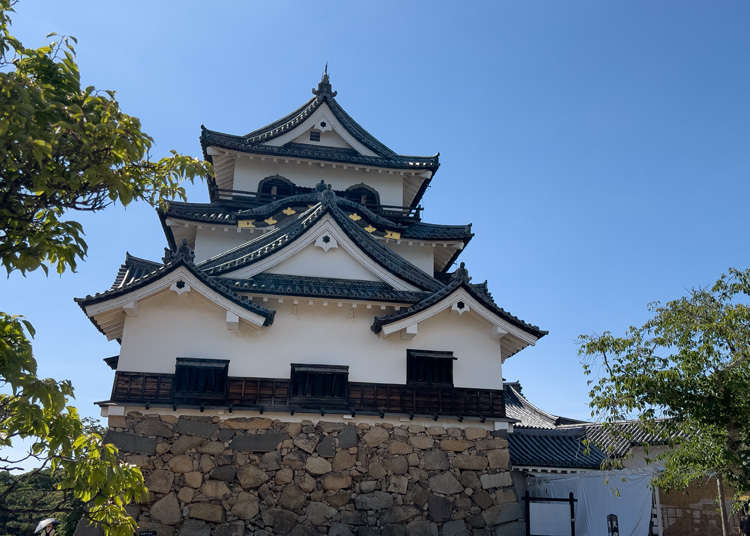
Hikone Castle is home to one of only 12 original castle keeps still standing in Japan, and it is designated a National Treasure. The keep is an elegant three-story, three-tier wooden structure with decorative gabled roofs.
That preserved wooden construction is part of what makes the visit feel different from later rebuilt castles. Inside, thick beams and pillars give a close view of historical craftsmanship rather than a modern reconstruction.
Visiting the keep: what to expect inside
Visitors must remove their shoes before entering the keep. The climb is also memorable for its steep wooden staircase, which rises at around a 62-degree angle. It was originally designed to make it harder for attackers to advance, but today it is one of the keep’s most distinctive features.
This is worth keeping in mind when planning what to wear. Socks with non-slip soles are a sensible choice, since the smooth wooden floors and stairs can feel slippery.
The effort pays off at the top. From the windows, you can see the historic castle town below, with Lake Biwa and the surrounding mountains in the distance. That combination of architecture and landscape is one of the clearest reasons to include Hikone in a Kansai historical itinerary.
Castle defenses worth paying attention to
The approach to the inner citadel is especially interesting for travelers who enjoy castle design. Two structures stand out: Tenbin Yagura and Taikomon Yagura.
Tenbin Yagura is an Important Cultural Property and is named for its balanced, symmetrical form. In front of it is the wooden Roka-bashi Bridge, which also had a defensive purpose. In the event of attack, it could be removed or destroyed, leaving enemies unable to cross the moat.
Further along is Taikomon Yagura, the last checkpoint before the keep. Its name comes from the large taiko drum that once sat inside to sound alarms and pass messages through the castle. Together, these structures show how Hikone combines beauty with practical defense.
For photography, the area around these gates is especially rewarding. Looking up from beneath the bridge can bring the stone walls, the wooden bridge, and the white walls of the turret into a single frame.
Don’t skip the rare castle stable
Another worthwhile stop is the Uma-ya Stable just outside the moat. It is a long, L-shaped wooden building and an Important Cultural Property. The stable is also described as the only surviving large-scale castle stable of its kind in Japan.
Inside were 21 stalls for horses belonging to the domain lord and senior samurai. For travelers interested in samurai culture, it adds a useful layer to the castle visit by showing how horsekeeping and martial life were part of the wider castle system.
Genkyu-en Garden: the best place for a reflection view
After the castle itself, Genkyu-en Garden is the natural next stop. Located on the northeast side of Hikone Castle, it is a classic pond-strolling garden modeled after the palace garden of Emperor Xuanzong of Tang China.
The garden includes pruned pine trees, rocks, and wooden bridges, but the standout draw is the view back toward the castle. From the right angle beside the pond, the National Treasure keep appears above the hillside and is reflected in the water below.
That reflection scene is one of the most photogenic parts of the visit, especially if you want a calmer contrast to the castle’s steep stairs and defensive structures.
Where to rest with matcha and wagashi
If you want a break after walking through the garden, Hosho-dai is a simple but appealing stop. This teahouse once welcomed guests of the domain lord and is now open to visitors.
It is a good place to pause over wagashi sweets and freshly whisked matcha while looking out over the garden. For travelers who like their sightseeing to include a quiet rest stop, this is one of the nicest ways to slow the day down.
Meeting Hikonyan
Hikonyan adds a completely different mood to the visit. The mascot is linked to the Ii clan’s history through its white cat design and red samurai helmet, and it helped spark the wider yuru-kyara mascot craze in Japan.
It only appears briefly at set times each day, usually in the plaza in front of the keep or at nearby facilities, so it is worth checking the official schedule before you go. If you want a good viewing spot, planning ahead matters.
There is also a Hikonyan Museum in the nearby shopping district. It shows the story behind the character and includes original artwork and limited-edition merchandise.
How much time to allow
This is a strong option for travelers who want a high-value day trip without leaving Kansai logistics behind. The route from Kyoto is straightforward, and the main sights are close enough together that you can cover the castle, garden, and mascot experience in one visit.
If you are deciding whether Hikone is worth it, the answer is yes if you want a historic outing that feels more spacious and less crowded than central Kyoto, while still delivering major visual highlights.
Practical travel tips
A few simple details can make the visit smoother:
- Wear socks that are comfortable on wooden stairs and floors.
- Be ready to remove your shoes before entering the keep.
- Plan extra time if you want to see Hikonyan, since appearances are limited.
- If photography matters to you, give yourself time both in the castle approach and in Genkyu-en Garden.
Because train times, opening hours, and mascot appearance schedules can change, it is wise to check current details before you go.
FAQ
How long does it take to get from Kyoto to Hikone Castle?
Around 50 minutes from JR Kyoto Station to JR Hikone Station on a Special Rapid train, with no transfers.
Can Hikone Castle be visited as a day trip from Kyoto?
Yes. The short, direct train ride makes it a practical day trip.
Why is Hikone Castle historically important?
It contains one of Japan’s surviving original castle keeps, and the keep is designated a National Treasure.
Do visitors need to remove their shoes inside Hikone Castle?
Yes. Shoes must be removed before entering the keep.
What should I wear or bring to climb the castle’s steep staircase comfortably?
Socks with non-slip soles are recommended because the stairs and floors are wooden and steep.
Where is the best place to photograph Hikone Castle with water reflection?
Genkyu-en Garden offers the reflection view of the keep on the water.
Can you meet Hikonyan during a visit?
Yes, but only at set times, so it is best to check the official schedule in advance.
What else is worth seeing besides the castle keep?
Tenbin Yagura, Taikomon Yagura, the Uma-ya Stable, Genkyu-en Garden, Hosho-dai, and the Hikonyan Museum are all worthwhile additions.